


Ethylenediaminetetraacetic Acid
Ethylenediaminetetraacetic Acid, commonly known as EDTA Acid, is an important chelating agent used in chemical manufacturing, metal ion control, and the production of EDTA salts. As the free acid form of EDTA, it is widely selected as a base material for further neutralization and conversion into disodium EDTA, tetrasodium EDTA, and other related derivatives.
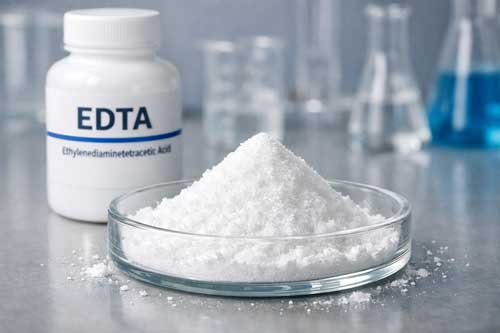
With strong complexing ability toward many multivalent metal ions, EDTA Acid plays a valuable role in industrial systems that require process stability, impurity control, and formulation flexibility. It is commonly supplied as a white crystalline powder and is suitable for use in a broad range of chemical processing applications.
Introduction to Ethylenediaminetetraacetic Acid
Ethylenediaminetetraacetic Acid is an organic compound known for its ability to bind calcium, magnesium, iron, copper, and other metal ions into stable complexes. This property makes it a widely recognized raw material in chelation chemistry.
In industrial practice, EDTA Acid is not only used directly in selected process systems but also serves as a key intermediate for manufacturing water-soluble EDTA salts. Because the acid form offers flexibility in downstream conversion, it is often preferred by manufacturers that produce multiple chelating products or require tighter control over neutralization conditions.
Synonyms and naming variations
This product may be listed under different names depending on market, supplier habit, or documentation format. Common names include:
- Ethylenediaminetetraacetic Acid
- EDTA Acid
- EDTA Free Acid
- Ethylene diamine tetraacetic acid
- EDTA
Although these names are often used interchangeably in trade communication, buyers should confirm the exact form being offered, especially when comparing the acid form with sodium salt products.
Relationship between EDTA Acid and EDTA
EDTA is a broader term often used to describe the entire family of EDTA-based chelating compounds. EDTA Acid refers specifically to the free acid form. This distinction is important because the acid form differs from EDTA salts in solubility, pH behavior, and end-use handling.
For example:
- EDTA Acid is commonly used as a raw material or intermediate
- Disodium EDTA is often preferred in formulations requiring easier dissolution
- Tetrasodium EDTA is selected where higher alkalinity or full neutralization is needed
Understanding this difference helps ensure correct product selection for manufacturing and purchasing.
Product Specifications
Below is a typical specification overview for industrial grade Ethylenediaminetetraacetic Acid. Exact values may vary depending on production standard and customer requirements.
Product Parameter Table
| Item | Specification |
|---|---|
| Product Name | Ethylenediaminetetraacetic Acid |
| Common Name | EDTA Acid |
| CAS Number | 60-00-4 |
| Molecular Formula | C10H16N2O8 |
| Molecular Weight | 292.24 |
| Appearance | White crystalline powder |
| Purity | 99.0% min |
| Chloride | 0.01% max |
| Sulfate | 0.05% max |
| Iron | 0.001% max |
| Heavy Metals | 0.001% max |
| Solubility | Slightly soluble in water |
| pH Value | Depends on dispersion and neutralization state |
| Standard Packaging | 25 kg bag |
| Shelf Life | Usually 24 months under proper storage conditions |
CAS number
The CAS number of Ethylenediaminetetraacetic Acid is 60-00-4. This identifier is used in technical documentation, customs records, SDS management, and product registration.
Appearance
EDTA Acid is generally supplied as a white crystalline powder. Depending on manufacturing method and drying conditions, slight variation in particle form may occur, but the product is typically free-flowing and suitable for industrial packing and transfer.
Purity
A typical industrial grade offers a purity of 99.0% minimum. Higher assay consistency is important for downstream salt production and stable process control, especially in applications where metal impurity management is critical.
Solubility
EDTA Acid is only slightly soluble in water, which distinguishes it from several of its sodium salt derivatives. This property is one reason why the acid form is often used as a conversion raw material rather than as a direct additive in highly aqueous systems.
Packaging
Standard supply is commonly arranged in 25 kg bags, with alternative packaging available upon request. Bulk bags and palletized export packing can also be provided for industrial and international shipment.
Major Applications
Chelation
The most important function of EDTA Acid is metal ion chelation. It forms stable complexes with many divalent and trivalent metal ions, helping reduce interference from hardness minerals and trace metal contamination.
This makes it useful in systems where uncontrolled metal ions may affect reaction quality, cause instability, or reduce product performance.
Chemical production
EDTA Acid is a commonly used intermediate in chemical manufacturing. It can be neutralized with alkaline materials to produce different EDTA salts according to target formulation requirements.
This allows manufacturers to adapt the same base raw material to multiple product lines while maintaining control over process parameters and final composition.
Salt manufacturing
A major commercial application of EDTA Acid is the production of:
- Disodium EDTA
- Tetrasodium EDTA
- Calcium disodium EDTA
- Other customized EDTA derivatives
For producers of chelating agents, using the acid form as an upstream material can simplify procurement and improve formulation flexibility.
Advantages in Industrial Use
Metal ion binding
EDTA Acid has strong affinity for many metal ions. This property helps reduce undesirable reactions caused by trace metals and improves chemical system control. In practical industrial use, strong metal binding contributes to cleaner process behavior and more reliable downstream performance.
Process stability
Metal contamination can lead to discoloration, reduced reactivity, precipitation, or shorter product stability. By controlling metal ion interference, EDTA chemistry supports more stable process conditions and more consistent batch-to-batch quality.
Raw material flexibility
Compared with purchasing only finished salts, using EDTA Acid offers greater flexibility for internal manufacturing. Producers can determine their own neutralization route, concentration, and final EDTA salt form based on process design and market demand.
This is especially useful for companies that:
- Produce multiple EDTA derivatives
- Require customized formulations
- Want stronger cost control in salt conversion
- Need more flexible production scheduling
Supply and Packaging Options
Bulk supply
For regular industrial users, EDTA Acid can be supplied in stable bulk quantities to support continuous manufacturing. Long-term supply arrangements are suitable for customers with recurring demand and fixed consumption planning.
Export packaging
For international shipments, export packing can be arranged with moisture-resistant inner liners, strong outer bags, palletization, and clear labeling. This helps maintain product integrity during storage, handling, and ocean or land transport.
Sample availability
Samples are typically available for laboratory evaluation and process testing. Sample confirmation is recommended before large-volume orders, especially when the product will be used for salt synthesis, impurity-sensitive processes, or specification matching.
Frequently Asked Questions
What is EDTA Acid used for
EDTA Acid is used as a chelating agent and as a raw material for producing EDTA salts. Its main function is to bind metal ions such as calcium, magnesium, iron, and copper, which helps improve chemical process stability and supports downstream manufacturing.
Is it the same as EDTA
EDTA Acid is the free acid form of EDTA. In general conversation, people often say EDTA when referring to EDTA Acid, but technically EDTA can also mean its related salts, such as disodium EDTA or tetrasodium EDTA. These forms differ in solubility and application characteristics.
How should it be stored
EDTA Acid should be stored in a cool, dry, and well-ventilated place. The container or bag should remain tightly sealed to avoid moisture absorption and contamination. It should be handled according to the relevant safety data sheet and kept under standard warehouse conditions.
Expanded FAQ
What is Ethylenediaminetetraacetic Acid
Ethylenediaminetetraacetic Acid, or EDTA Acid, is an organic chelating agent used to bind metal ions. It is widely used in chemical manufacturing and as a raw material for producing EDTA salts.
What is EDTA Acid mainly used for
EDTA Acid is mainly used for metal ion chelation and for manufacturing EDTA derivatives such as disodium EDTA and tetrasodium EDTA. It helps control metal impurities and improves process consistency.
Is EDTA Acid the same as EDTA
EDTA Acid is one form of EDTA. It specifically refers to the free acid form, while EDTA may also describe a broader group of related salts and derivatives.
What is the CAS number of EDTA Acid
The CAS number of Ethylenediaminetetraacetic Acid is 60-00-4.
What does EDTA Acid look like
EDTA Acid is usually supplied as a white crystalline powder. The exact particle form may vary slightly by manufacturing process.
Is EDTA Acid soluble in water
EDTA Acid is only slightly soluble in water. For applications requiring easier dissolution, users often select one of its sodium salt forms instead.
Why is EDTA Acid used to make EDTA salts
EDTA Acid is used to make EDTA salts because it serves as the base intermediate for controlled neutralization. This allows manufacturers to produce different salt forms according to solubility, pH, and formulation requirements.
How should EDTA Acid be stored
EDTA Acid should be stored in a dry, cool, and well-ventilated area in sealed packaging. Proper storage helps maintain quality and prevents moisture-related handling issues.
What packaging is available for EDTA Acid
EDTA Acid is commonly packed in 25 kg bags. Jumbo bags, palletized export packaging, and customized packing options may also be available depending on order volume and shipping requirements.