


EDTA Acid Uses in Chelation and Chemical Processing
What Is EDTA Acid Used For?
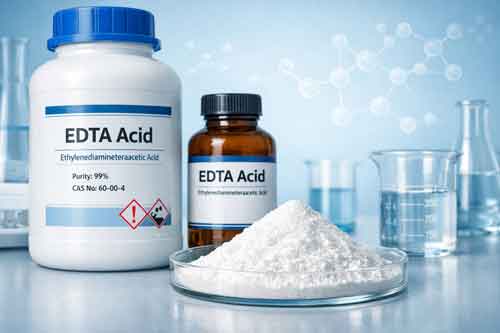
EDTA Acid is widely used in industry as a chelating agent, process-support chemical, and intermediate for the production of EDTA salts and related products. Its main value comes from its strong ability to interact with metal ions that may otherwise interfere with processing, formulation stability, or product quality.>
In practical manufacturing environments, metal ions such as calcium, magnesium, iron, and copper can create unwanted side effects. These may include reduced reaction consistency, color change, precipitation, deposit formation, or lower storage stability. EDTA Acid helps manage these issues by binding with many of these ions and reducing their interference in controlled systems.
Beyond direct chelation use, EDTA Acid is also an important upstream raw material. Many manufacturers purchase the acid form because it gives them flexibility to convert it into different salts according to their own production requirements. This makes it useful not only as a functional chemical, but also as a strategic material in chemical processing and product development.
General industrial functions
EDTA Acid serves several general industrial functions. It may be used to support metal ion management, improve process consistency, and provide a starting point for downstream EDTA-based products. In chemical plants, this combination of functionality and conversion flexibility makes it a practical material for routine production use.
Its role often depends on the final process design. In some cases, it is used to control trace metals in a working system. In other cases, it is selected mainly as a raw material for conversion into more soluble or application-specific EDTA salts.
Role in metal ion control
One of the core uses of EDTA Acid is metal ion control. In industrial processing, even small amounts of dissolved metal ions can affect the outcome of a reaction or reduce the stability of a finished product. EDTA Acid helps reduce this influence by forming stable complexes with many metal ions.
This control is especially valuable when production systems require cleaner reaction conditions, better repeatability, or lower sensitivity to water hardness and trace metal contamination.
EDTA Acid in Chelation
Chelation is the most recognized function of EDTA Acid. A chelating agent works by surrounding and binding metal ions, making them less reactive in the system. This can help prevent undesirable interactions and improve the overall control of a chemical process.
EDTA chemistry is widely valued because it can interact with a broad range of metal ions under suitable conditions. The acid form itself is an important part of this chemistry, especially where manufacturers want to manage formulation pathways or use it as the base for conversion into salt forms with improved handling properties.
Why chelation matters
In many industrial systems, metal ions are not intentionally added, but they still appear through water, raw materials, equipment contact, or storage conditions. Once present, they may trigger oxidation, destabilize sensitive ingredients, or interfere with target reactions.
Chelation matters because it gives manufacturers a way to reduce that interference. By tying up troublesome ions, the process becomes easier to control. This can help improve consistency, reduce waste, and protect product quality across production batches.
How EDTA Acid supports chelation processes
EDTA Acid supports chelation processes by acting as the parent chelating compound in many EDTA-based systems. It provides a strong foundation for complexing metal ions and is also used when manufacturers want to prepare specific EDTA salts in-house for tailored performance.
Its use in chelation-related processing is often linked to applications where hardness control, trace metal management, or controlled reaction conditions are important. In this sense, EDTA Acid is not only a standalone product but also a base component in broader chelation technology.
EDTA Acid in Chemical Processing
In chemical processing, EDTA Acid is used as more than a simple additive. It can function as a process-support material that helps improve reaction control and manufacturing reliability. Depending on the production route, it may be introduced to reduce the impact of metallic impurities or used upstream in the preparation of derivative products.
Because chemical plants often handle variable feedstocks, water quality differences, and multiple reaction stages, the ability to manage metal-related interference can be highly valuable. EDTA Acid contributes by making such systems easier to standardize and less sensitive to impurity fluctuations.
Process aid functions
As a process aid, EDTA Acid may help reduce metal-related instability in chemical operations. This can support cleaner reactions, better clarity in certain systems, and improved control over production conditions. The exact benefit depends on the formulation and the process environment, but the overall purpose is usually the same: to minimize the impact of unwanted metal ions.
Where process precision matters, this function can support smoother plant operation and more predictable output.
Production support uses
EDTA Acid also has value in production support. It can be integrated into manufacturing workflows as a technical raw material for conversion, adjustment, or formulation development. For producers making EDTA derivatives, the acid form offers a practical base for controlled neutralization and flexible product design.
This makes it particularly useful in facilities that aim to serve multiple product grades or customer specifications from one core intermediate.
EDTA Acid as a Raw Material
One of the most important commercial uses of EDTA Acid is as a raw material. Rather than purchasing only finished salts, some manufacturers prefer the free acid form because it gives them greater control over downstream processing. They can adjust neutralization level, salt type, and product characteristics according to their own technical and commercial needs.
This is especially relevant in companies that produce chelating products in different forms. Using EDTA Acid as a starting material can simplify sourcing strategy while supporting a wider product range.
Use in salt production
EDTA Acid is commonly used to manufacture a range of EDTA salts, including disodium EDTA and tetrasodium EDTA. Through neutralization with suitable bases, the acid form can be converted into products with different solubility profiles and formulation characteristics.
This conversion pathway is one of the key reasons EDTA Acid remains important in industrial supply chains. It gives producers flexibility to align final output with market demand and technical application needs.
Use in downstream chemical products
Beyond salt production, EDTA Acid may also be used in the preparation of downstream chemical products that rely on chelation chemistry or controlled metal ion behavior. As an intermediate, it supports formulation development and customized product manufacturing where a reliable base material is required.
Its value in these applications lies in its versatility. By starting from the acid form, producers can build different downstream solutions while keeping greater control over processing steps.
Benefits of EDTA Acid in Industry
EDTA Acid remains a preferred industrial material because it combines functional performance with processing flexibility. For many manufacturers, it is not simply a chemical input, but a tool for improving consistency, expanding product options, and managing process variables more effectively.
Efficiency
EDTA Acid can improve efficiency by helping reduce the disruption caused by uncontrolled metal ions. Better control of these impurities often means fewer process deviations, lower risk of quality issues, and more stable production results.
When used as a raw material, it can also support efficient internal conversion into different salt forms, reducing dependence on separately sourced derivative products.
Stability
Industrial processes often depend on stable operating conditions. EDTA Acid supports stability by reducing the influence of metals that may otherwise trigger side reactions or affect formulation integrity. This can contribute to more uniform output and improved batch reproducibility.
In supply and processing terms, the acid form also offers a stable intermediate for manufacturers that want more control over downstream product preparation.
Versatility
Versatility is one of the strongest advantages of EDTA Acid. It can be used in chelation-related systems, in production support roles, and as a precursor for multiple EDTA derivatives. This allows one product to serve several industrial purposes, which is valuable in operations that require both technical flexibility and inventory efficiency.
FAQs About EDTA Acid Uses
What industries use EDTA Acid?
EDTA Acid is used in chemical manufacturing and related industrial sectors where metal ion control, chelation performance, or EDTA salt production is required. It is especially relevant for manufacturers that produce chelating agents or use them in process systems.
Why is it preferred in some processes?
EDTA Acid is preferred in some processes because it helps control unwanted metal ions and can also serve as a flexible intermediate for downstream product conversion. This combination of technical function and raw material value makes it useful in operations that require both performance and adaptability.
Can it be used as an intermediate?
Yes. EDTA Acid is widely used as an intermediate, particularly in the production of EDTA salts and other downstream products based on chelation chemistry. Many manufacturers choose the acid form specifically because it allows more controlled conversion during production.